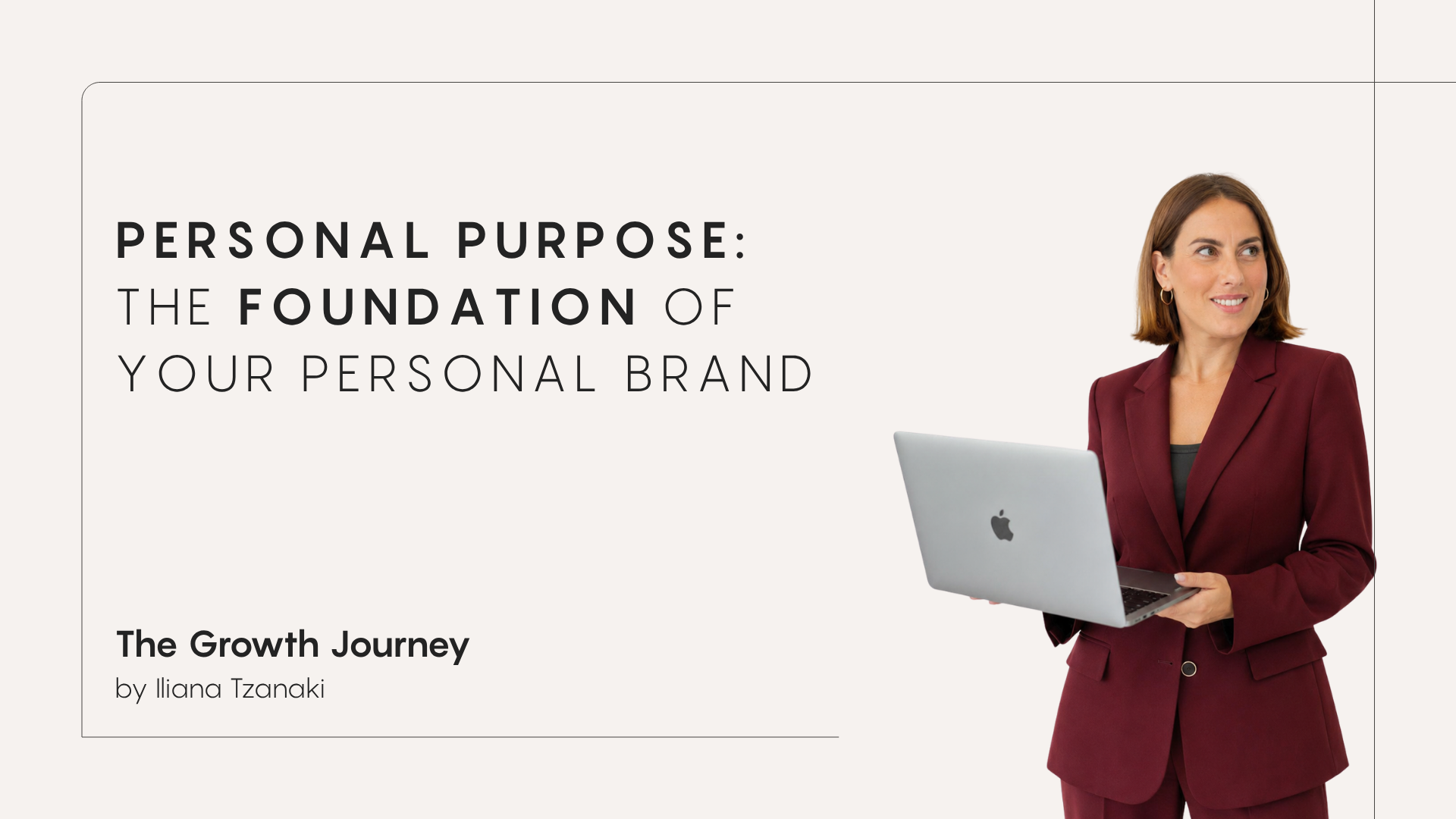
Personal Purpose: The Foundation of Your Personal Brand
We spend a lot of time thinking about how we want others to see us.
How we present ourselves.
How we communicate our value.
How we build our personal brand.
But there is a more fundamental question we should ask first:
Do we know who we are beyond the image we want to project?
Personal branding can help people understand what you bring to the table. But without a clear sense of personal purpose, it can easily become an exercise in managing perceptions rather than expressing who you genuinely are.
And I believe that is where the real work begins.
Personal purpose is understanding what matters to you, what drives you, what you stand for, and how you want to contribute.
It is not necessarily about finding one extraordinary mission or having every aspect of your life figured out.
It is about having a clearer understanding of yourself — and using that understanding to make more intentional decisions.
It starts with authenticity.
For me, authenticity is not about sharing everything about yourself or behaving exactly the same way in every situation.
It is about alignment.
Your values should not disappear when you enter the workplace. Your principles should not become negotiable because of your job title. And your professional identity should not require you to become someone you would not recognize outside work.
We have different responsibilities in different environments. We adapt how we communicate, how we lead, and how we collaborate.
But adapting is not the same as pretending.
You are one person. Your professional life is part of your life, not a separate identity you have to perform.
When there is a significant gap between who you are and who you feel you need to be at work, it is worth asking why.
Sometimes, the answer is that we need to develop new skills or become more comfortable with unfamiliar responsibilities. Other times, it may be a sign that our current environment, role, or direction no longer aligns with what matters to us.
Recognizing the difference takes self-awareness.
So, how do you find your personal purpose?
It doesn’t begin with choosing an inspiring statement for your LinkedIn profile.
It begins with asking better questions.
- What matters to me? Which values am I unwilling to compromise, even when doing so would be easier?
- When do I feel most like myself? What am I doing, who am I working with, and what kind of contribution am I making?
- What comes naturally to me? Which strengths do I consistently bring to situations, and how could I use them more intentionally?
- What do I want my work to contribute? Beyond salary or status, what makes the effort meaningful to me?
- What am I currently tolerating that no longer aligns with who I am becoming?
These questions are not a checklist that produces an immediate answer. They are a starting point for reflection.
The next step is to look for patterns in your experiences, seek honest feedback, and test your conclusions through action.
Pay attention to the work that energizes you, the responsibilities that feel meaningful, the environments in which you do your best work, and the choices that leave you feeling proud of how you acted.
Then bring those insights into your decisions.
Purpose becomes useful when it influences what you say yes to, what you say no to, what you develop, and where you choose to invest your time and energy.
Purpose Is the Foundation
Your priorities may change. Your ambitions may evolve. What felt meaningful at one stage of your life may no longer be enough at another.
That doesn’t mean you have lost your purpose. It means you need to keep understanding yourself as you grow.
Personal purpose is not a destination you reach once. It is the foundation from which you make decisions, shape your identity, and decide how you want to contribute to the world.
In career development, this matters because a successful career is not simply one that looks good from the outside. It is one you build deliberately, in a way that reflects your strengths, values, ambitions, and the life you want to lead.
And the same principle extends beyond work. Your professional identity should not be disconnected from the person you are in your everyday life.
The goal is not to create a perfect professional image. It is to build a life and career in which the person you are, the work you do, and the choices you make are increasingly aligned.
Before you build your personal brand, understand your personal purpose.
Because the strongest professional identity is not a version of yourself you create for other people. It is a clearer expression of who you are, what you stand for, and the value you bring.
And when you understand that, you can communicate your value with greater clarity, make more intentional career decisions, and build a professional identity that feels authentic to you.
This is where meaningful career development begins.
If you’re ready to gain clarity on your professional direction, strengthen your positioning, and build a career that reflects who you are and where you want to go, let’s work on it together.
Explore my Career Coaching services or book a call with me to discuss your next step.